

Back to All posts
SUSTAINABILITY
A New Standard for Sustainability on Ancestral Land
Words: Rachel Smith
Sustainability at Sen̓áḵw is nothing new. It's a continuation of the principles that have guided the Sḵwx̱wú7mesh Úxwumixw since time immemorial, grounded in the belief that thriving depends on reciprocity between people, the land, and the generations who follow.
For something new to rise here, it begins the old way: with intention. Guided by the Nation's Climate Action Strategy, Sen̓áḵw champions energy efficiency, emissions reduction, and long-term stewardship. That vision has made Sen̓áḵw the largest net zero operational real estate development in First Nations history, and among the largest in Canada overall.
"Everything we're building stems from that vision. It's how we think in terms of seven generations ahead."
"The Squamish Nation's climate strategy is where projects like Sen̓áḵw are empowered," says Trevor Casey, Director of Development and Construction at Nch'ḵay̓. "Everything we're building stems from that vision. It's how we think in terms of seven generations ahead."
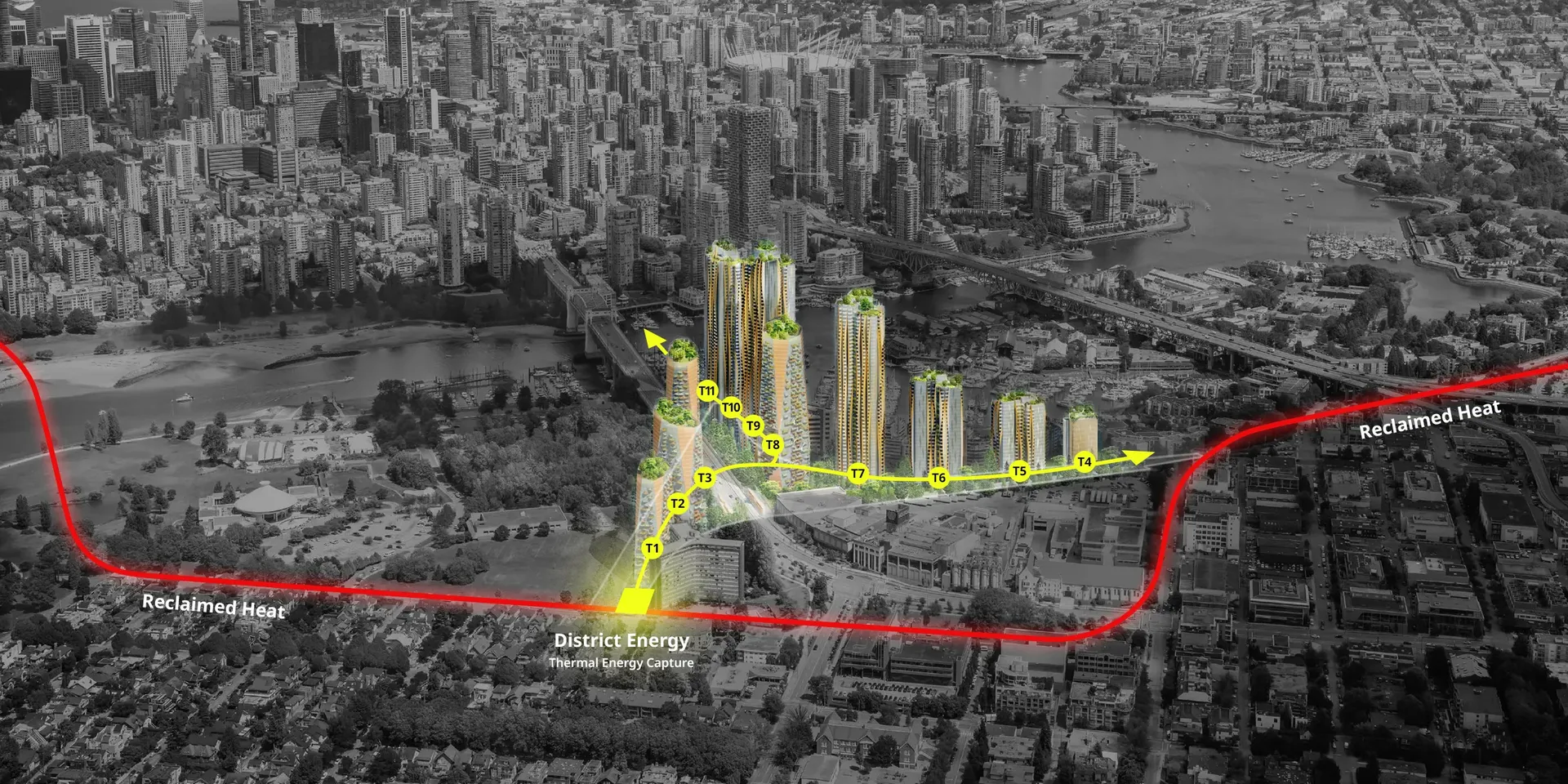
At the centre of Sen̓áḵw's sustainability strategy is a district energy plant operated by Creative Energy. Built within Phase One of the parkade, the 20,000-square-foot facility captures thermal energy from a Metro Vancouver wastewater line, converting waste heat into clean energy for heating and cooling. The plant will serve all 11 residential towers, which together total more than four million square feet, with capacity to support future neighbouring projects.
The investment in clean energy is long-term by design. "It's a massive upfront investment," says Casey. "But it pays back over time, environmentally, economically, and in setting a standard for what's possible."
Sustainability at Sen̓áḵw extends beyond energy. It's built into daily life. With only two levels of parking and a 10 percent ratio across all phases, the design reduces both embodied carbon and reliance on cars.
To make that shift seamless, Sen̓áḵw is investing in active and public transportation: a new transit hub on the Burrard Bridge, upgraded bike lanes, and improved pedestrian paths connecting to False Creek, Kitsilano, and downtown.
Here, cycling has its own place in the plan, with a ramp built just for bikes, connecting riders directly into the parkade with secure storage, repair, and wash facilities on site. "Reducing parking only works if you build the infrastructure that lets life thrive without a car," says Casey.




Privacy Policy
Copyright © Nch'ḵay̓ West 2026
The developer reserves the right to modify or make substitutions to the building design, specifications and floorplans should they be necessary. Prices are subject to change without notice. Renderings, views, measurements, and layouts are for illustration purposes only. E.&O.E.
This site is protected by reCAPTCHA and the Google Privacy Policy and Terms of Service apply.
The developer reserves the right to modify or make substitutions to the building design, specifications and floorplans should they be necessary. Prices are subject to change without notice. Renderings, views, measurements, and layouts are for illustration purposes only. E.&O.E.
This site is protected by reCAPTCHA and the Google Privacy Policy and Terms of Service apply.
Privacy Policy
Copyright © Nch'ḵay̓ West 2026